

You’ve tried keto. You’ve tried cutting carbs, counting calories, and meal prepping on Sunday afternoons, and you’ll never get back.
Maybe you even found yoga, started meditating, and began paying attention to what you put in your body. And still — something isn’t clicking.
You’re not lazy. You’re not lacking willpower. You’re exhausted from a decade of conflicting advice that somehow always ends the same way: you’re right back where you started, feeling worse about yourself than before you even tried.
Here’s what nobody in the diet industry wants to admit: why diets don’t work has nothing to do with your willpower, your discipline, or your commitment. The problem is the approach.
Most diets are built on a simple formula — restrict, endure, lose weight, feel better about yourself. But that formula has a fatal flaw. It treats your body like a problem to be solved and your mind like an obstacle to be overridden. It completely ignores the one thing that actually drives lasting change: your relationship with yourself.
That’s what this article is about.
Not another meal plan to follow perfectly for three weeks before life gets in the way. Not another list of foods to cut out or rules to memorize.

This is about understanding why diets don’t work — for you, for most people, for anyone who has ever stood in a kitchen at 10 pm wondering why they can’t just get this right — and what research and real experience suggest actually does.
You’ll find a practical introduction to mindful eating: what it is, how it works, and why it’s fundamentally different from every diet you’ve tried before. You’ll also find a 21-day meal framework grounded in whole, real food — not as a magic solution, but as a structured starting point while you rebuild a healthier relationship with eating.
And if you find yourself reading this thinking I need more than a blog post — I need to actually step away and reset — we’ll share a bit about what that looks like too.
But first: let’s talk about why everything you’ve been told about losing weight has made this harder, not easier.
Why Diets Don’t Work (And Why You Keep Blaming Yourself)
Most people who struggle with their weight aren’t struggling because they lack information. They’re struggling because every system they’ve tried has asked them to fight against themselves — their hunger, their cravings, their schedule, their stress — and eventually, that fight gets exhausting.
The cycle is familiar. You start strong. You follow the rules. Then life happens — a stressful week, a social event, a moment of genuine hunger — and suddenly you’ve “failed.” The guilt sets in, and before long, you’re back to square one, carrying not just the original weight but a new layer of shame on top of it.
This is not a personal failure. This is what the cycle is designed to do.

The Diet Cycle That Keeps You Stuck
Breaking a deeply ingrained cycle on your own — in the same environment, under the same pressures — is hard. There’s a reason structured retreat experiences produce results that home-based programs rarely do. Read more about what makes a retreat different from doing it alone.
Restrictive diets create a physiological and psychological loop that’s genuinely hard to escape:
- Restriction triggers hunger signals and stress hormones
- Hunger and stress wear down decision-making over time
- A moment of eating “off plan” gets labeled as failure
- Failure triggers guilt, which triggers emotional eating
- Emotional eating triggers renewed restriction — and the cycle starts again
Understanding this loop is the first step toward breaking it. It’s not a weakness. It’s biology meeting an unsustainable system.
Why Diet Culture Sets You Up to Fail
Diet culture operates on one foundational promise: change how you look, and you’ll feel better about yourself. Lose the weight first, then earn the confidence. This is precisely why diets don’t work long-term for the vast majority of people who try them.
Research consistently shows that external changes — weight loss, new clothing, a number on a scale — produce only temporary shifts in how people feel about themselves. Lasting self-confidence comes from how you treat yourself, not what you weigh. When you start from that premise, the entire framework of dieting begins to unravel.

The Guilt Trip That Comes With Every Meal
One of the most underreported costs of chronic dieting is what it does to your relationship with food itself. For many people, every eating decision carries an emotional charge — eating something “bad” triggers guilt, eating something “good” feels like compliance rather than pleasure. Neither state is nourishing.
Mindful eating for weight loss starts here: with dismantling the moral framework around food. Food is not a reward or a punishment. It is nourishment, pleasure, culture, and connection. Reclaiming that understanding is not a soft or optional part of the process — it is the foundation.
Why Punishing Yourself Doesn’t Lead to Lasting Change
The uncomfortable truth about willpower-based approaches is that they borrow energy from the future. You can white-knuckle your way through a restrictive plan for weeks — but the restriction itself creates the conditions for the rebound. Studies on chronic dieters consistently show that rigid restraint predicts overeating episodes, not prevents them.
Lasting change comes from building habits that feel sustainable, even enjoyable — not from enduring suffering long enough to earn a result.
If you’ve read this far and thought, “I need more than a blog post — I need to actually step away and reset” — that instinct is worth listening to.

What Is Mindful Eating for Weight Loss?
Movement is a natural companion to mindful eating — and not the punishing kind. If you’re curious how gentle, intentional practice fits into this picture, read our guide to yoga for weight loss and how it works alongside awareness-based eating.
Mindful eating is not a diet. It has no banned foods, no points system, and no prescribed meal windows. What it has is a fundamentally different relationship between you and what you eat.
Once you understand why diets don’t work at a physiological and psychological level, mindful eating stops feeling like a compromise and starts feeling like relief.
Diet Mindset vs. Mindful Eating comparison table:
| Diet Mindset | Mindful Eating |
|---|---|
| Food is good or bad | Food is information |
| Eat by the rules | Eat with awareness |
| Guilt when you break it | Curiosity when you notice |
| Finish the plan | Build a practice |
| External motivation | Internal connection |
At its core, mindful eating means bringing conscious awareness to your eating experience — why you’re eating, what you’re eating, and how it actually makes you feel. It draws from mindfulness practice: present-moment awareness, non-judgment, and curiosity over control. For anyone who has spent years eating on autopilot — at a desk, in a car, in front of a screen — this shift alone can be genuinely transformative.
1. Eat for What Your Body Actually Needs
Not every urge to eat is hunger. Stress, boredom, habit, and emotional discomfort all trigger eating — and most of us have spent so long overriding our natural hunger signals with external rules that we’ve lost touch with what genuine physical hunger actually feels like.
Mindful eating rebuilds that awareness. Over time, you learn to distinguish:
- Physical hunger from emotional hunger
- Genuine cravings from habitual reach
- Satisfaction from fullness
- Nourishment from comfort
This isn’t about rigid control. It’s about developing an honest, curious relationship with your body’s actual signals.
2. Get Curious About What You’re Eating
What you eat matters — but so does how well your body processes it. Certain yoga practices directly support your digestive system, which plays a bigger role in how food makes you feel than most people realize. Learn more about how yoga supports healthy digestion.

Where did it come from? What’s actually in it? How does it make you feel — during, and an hour later?
Most people eat the same foods on rotation without ever really paying attention to how those foods affect their energy, their mood, or their digestion. Mindful eating asks you to slow down enough to notice. Not to judge — just to observe.
This kind of body awareness naturally shifts eating patterns over time, without the need for external rules. When you genuinely notice that a certain lunch leaves you sluggish by 3 pm, you start wanting something different — not because a plan told you to, but because your own experience did.

3. Slow Down and Savor Every Bite
Slowing down at meals also gives your digestive system the conditions it needs to actually do its job well. Certain yoga practices reinforce this further — here’s a closer look at yoga practices that support digestion and gut health.
Satiety signals take approximately 20 minutes to reach the brain from the stomach. Most people eat a full meal in less time than that, which means by the time your body registers it’s satisfied, you’ve already eaten past that point.
Slowing down is one of the simplest, most evidence-backed behavioral shifts in mindful eating research. It sounds almost insultingly simple. It also genuinely works.
A Structured Starting Point: The 21-Day Mindful Eating Framework
If you want a practical framework while you build these new habits, a short-term structure can help — not as a rigid set of rules to follow perfectly, but as a scaffold while you practice eating with more awareness.
The approach here, drawn from Dr. Philip Goglia’s work on metabolism and whole-food nutrition, centers on small, frequent meals of real, unprocessed food throughout the day — farm-fresh proteins, vegetables, and whole grains — paired with consistent hydration and moderate movement.
The goal is not perfection. It’s building the awareness that makes lasting change possible.
How a Body and Mind Retreat Helps You Find Balance
Why Willpower Alone Isn’t Enough
The body and mind reset we’re describing isn’t just about food. Movement — specifically the kind that builds body awareness rather than burns calories — is an equally important part of the picture. Read more about how yoga and mindful eating work together for lasting change.
Everything covered in this article points to the same conclusion: the environment you’re in shapes your habits more powerfully than your intentions do. Changing how you eat while living the same life, under the same stressors, surrounded by the same triggers, is genuinely hard. This is not an excuse — it’s a design problem. And sometimes the most effective solution is to change the environment entirely, even temporarily.
That’s what a retreat offers. Not escape, but reset.
Not sure which retreat is the right fit for where you are right now? We’ve put together a guide to the best yoga retreats in Costa Rica for 2026 across every experience level.

What a Detox Retreat in Costa Rica Actually Looks Like
Blue Osa has been recognized as one of the leading wellness destinations in Central America. If you want to understand what makes it different before you consider booking, start with our award-winning yoga retreat in Costa Rica overview.
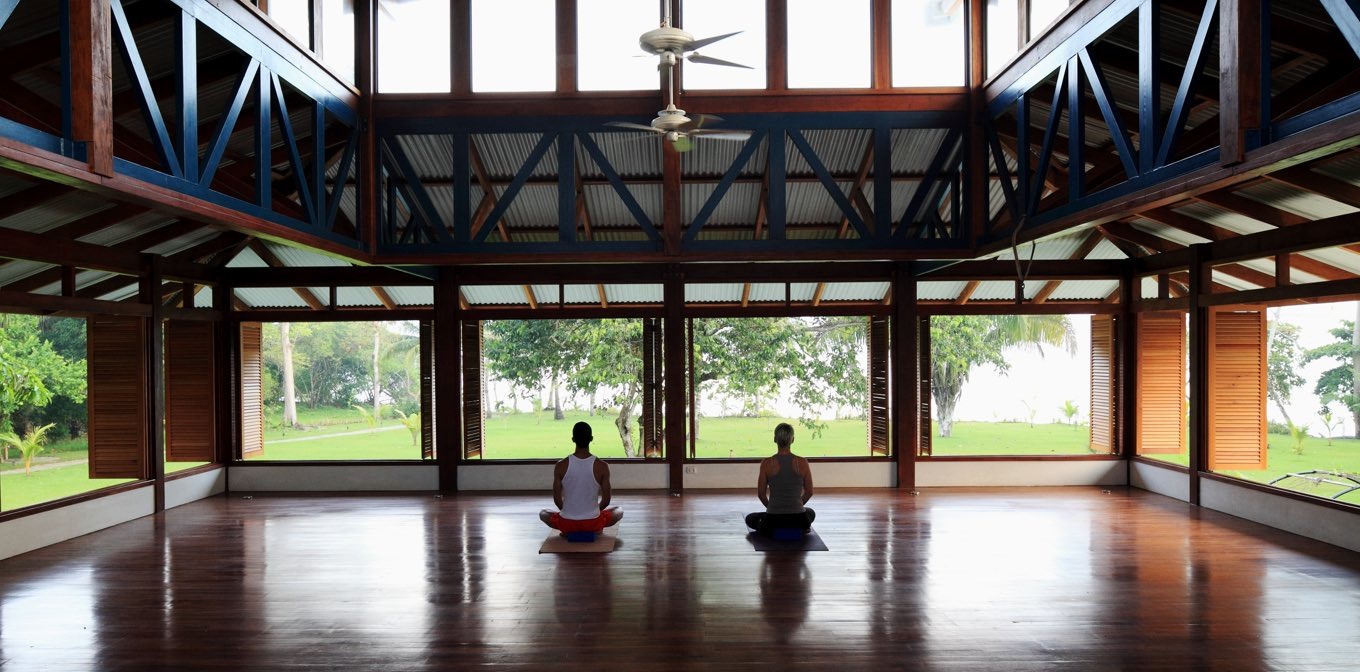
Picture waking up without an alarm. Breakfast is whole, farm-fresh food prepared for you. Your morning includes yoga and movement that feels restorative rather than punishing. Your afternoon has space — for reflection, for nature, for simply being somewhere that isn’t your inbox.
At Blue Osa, the days are structured but not rigid. The focus is on rebuilding the connection between body and mind that chronic stress and diet culture quietly erode. Surrounded by the rainforest and the Pacific coast of Costa Rica’s Osa Peninsula, the environment itself does much of the work.
Guests consistently describe the same shift: within a few days, the mental noise quiets. Eating becomes pleasurable again. Movement feels like self-care rather than penance. The relationship with food begins to change — not because someone handed them a new set of rules, but because they finally had the space to hear their own body.
Before you book, it helps to know what Costa Rica is actually like. We’ve put together 33 essential facts about Costa Rica every first-time visitor should read.

How Blue Osa Helps You Reset Body, Mind and Weight
Blue Osa is not a weight loss clinic. It’s a yoga and wellness retreat that addresses the root causes of what drives most people’s difficult relationship with their body: chronic stress, disconnection, exhaustion, and the absence of genuine self-care.
For many Blue Osa guests, the retreat is the moment it finally clicks — not just intellectually knowing why diets don’t work, but viscerally experiencing what the alternative actually feels like.
Guests leave with a different relationship with themselves. That shift is what makes the changes stick long after they return home.
Still weighing whether a retreat is right for you? We put together an honest look at 10 reasons to choose Blue Osa for your retreat — from the food and the setting to the people and the philosophy.
If this article has made you wonder whether a week away could be the reset you’ve been looking for, the Blue Osa yoga and wellness retreat is a good place to start exploring.
Ready to experience what a genuine body and mind reset feels like?
Frequently Asked Questions
Q1: Why do diets stop working after a few weeks?
Most diets create a restriction cycle that’s physiologically unsustainable. When you restrict food significantly, hunger hormones increase and stress hormones rise — making it progressively harder to maintain the plan. The diet fails by design, not because you did.
Q2: What is mindful eating and how is it different from a diet?
Mindful eating is about building awareness of why and how you eat, rather than following external rules about what you can and can’t have. There are no banned foods and no points system — just a growing, honest relationship with your body’s actual signals.
Q3: Can mindful eating actually help with weight loss?
Research suggests that people who eat mindfully tend to eat less without feeling deprived, make more nourishing food choices naturally over time, and maintain those changes longer than people following restrictive plans. The shift is slower but significantly more durable.
Q4: What does a wellness retreat in Costa Rica actually do for your relationship with food?
Removing yourself from your usual environment — the stress, the habits, the triggers — gives your nervous system space to reset. Many people find that in a structured retreat setting, their relationship with food shifts naturally without anyone prescribing rules, simply because the conditions that drove stress eating are temporarily absent.
Q5: How do I start eating more mindfully if I’ve been dieting for years?
Start with one meal a day where you eat without screens, without rushing, and without judging what’s on your plate. Notice flavors, textures, and how you feel before and after. That single habit, practiced consistently, is where most people begin to notice a genuine shift.
About The Author, Yogi Aaron

Yogi Aaron is the founder and creator of Applied Yoga Anatomy + Muscle Activation™ (AYAMA), a revolutionary methodology that challenges conventional approaches to yoga. Using a science-backed approach, he prioritizes muscle activation over traditional stretching.
With over three decades of dedicated study, mentorship, and hands-on experience, he has established himself as a leading expert in yoga therapy, alignment, and pain-free movement.
As owner and operator of Blue Osa Yoga Retreat + Spa in Costa Rica, Yogi Aaron leads transformative programs that combine his expertise in yoga instruction, retreat facilitation, and wellness business operations. His work spans both in-person immersive experiences and digital education through The Yogi Club online platform and the AYAMA™ Certification Program.
Yogi Aaron’s teaching methodology represents a paradigm shift in modern yoga practice. AYAMA focuses on activating and engaging muscles to enhance range of motion, build strength, improve stability, and optimize alignment—while reducing pain and injury risk. This evidence-based approach has positioned him as a thought leader challenging the status quo in the yoga community.
His mission extends beyond the mat: to liberate individuals from chronic pain and guide them toward discovering yoga’s authentic purpose through intelligent, body-informed practice.
Learn more about training opportunities with Yogi Aaron at Blue Osa Yoga Retreat + Spa.
Check out these other popular posts!

5 Life-Changing 2026 Yoga Retreats Costa Rica

5 Reasons To Book a Week-Long Yoga Vacation in Beautiful Costa Rica

How to Improve Digestion Problems Naturally: Yoga, Breath & Nutrition
Tags: Health
Book/Inquire Now
Got pain? This will help you!

YOU DESERVE TO LIVE PAIN-FREE...
Receive 7 short, simple, and effective practices to alleviate knee, hip, low back, neck, shoulder pain, and more!
All you need is 5 minutes per lesson and it's FREE!
This revolutionary approach to yoga is new, and no one else is teaching this! Since I created Applied Yoga Anatomy + Muscle Activation™ and started teaching it consistently, I've witnessed students heal long-standing injuries, access yoga postures they never thought possible, and tell me over and over again how their body just feels better.
I hope you'll join me on this journey!
~Yogi Aaron

Is Yoga Teacher Training Right For Me?
We Created This FREE 5 Part Series So You Can Get All The Information To Make The Right Choice.
In this series, you will learn:
-
- Am I a candidate for yoga teacher training??
-
- What will I learn in a YTT?
-
- Do I need to have a perfect downward dog to attend YTT?
14-Day 200-Hour Yoga Teacher Training in Costa Rica

If you are looking for a 14-day 200 hour Yoga Teacher Training Costa Rica Immersion, you have landed in the right place. Join the next one!
300-Hour, 28-Day Yoga Teacher Training
Do You Feel Called To Something Greater?
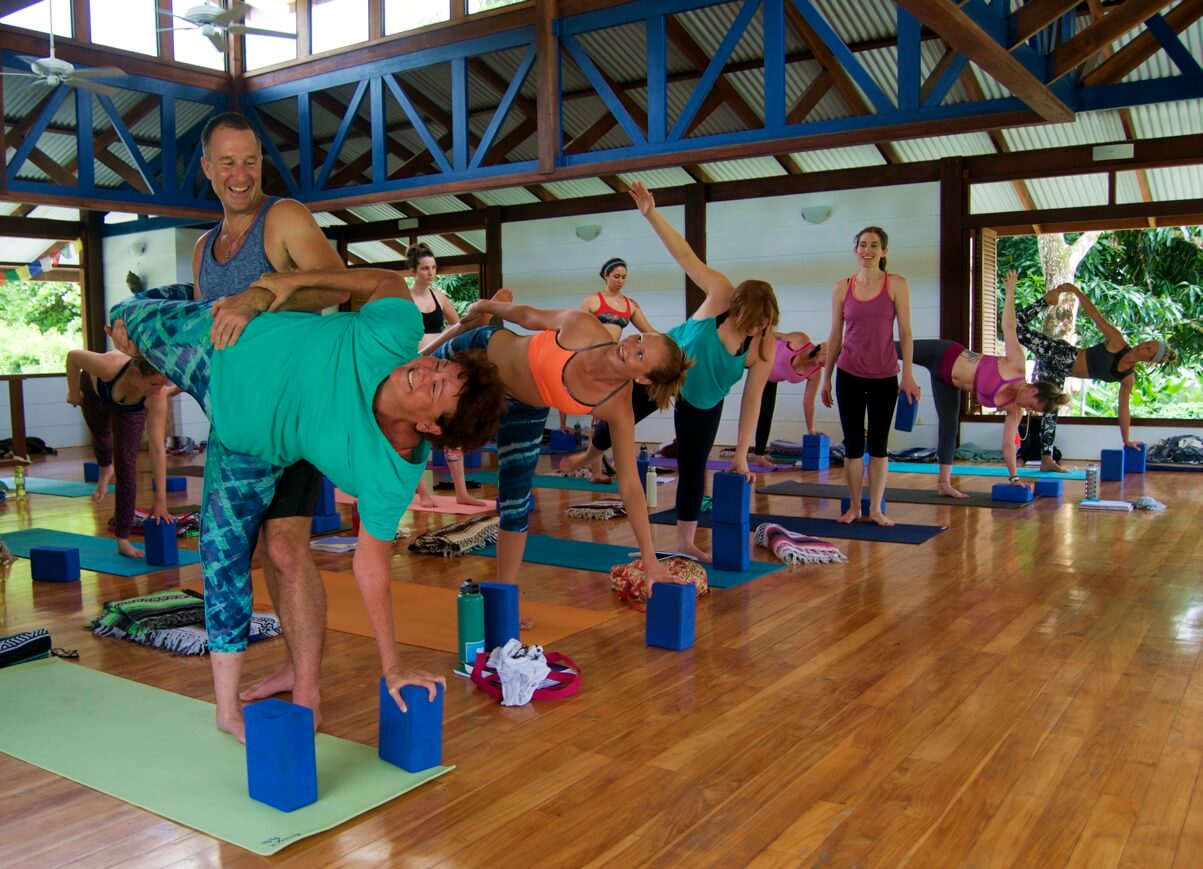
This 300-Hour Yoga Teacher Training immersion training at Blue Osa will immerse you in yoga for one month.
You will have the specific transformational skills and yogic practices you need in order to connect with your higher purpose.
And more! You will be able to offer these transformative skills to others!
