

You’ve been practicing yoga for years. You know the poses. You know how your body feels as you move through a sequence. But the moment someone asks you to explain why a student’s knee is tracking inward in Warrior II, or how to modify a backbend for someone with a herniated disc safely, you feel the gap.
That gap is exactly what yoga anatomy for yoga teachers is designed to address — and most training programs out there don’t go nearly deep enough.
And for most yoga practitioners considering their first teacher training — or already teaching — it’s the source of a quiet, persistent worry. What if I hurt someone? What if a student asks me something I can’t answer? What if I’m not knowledgeable enough to actually do this?
Those fears are valid. They’re also exactly why anatomy and physiology training isn’t just another module to check off your 200-hour curriculum. There is a difference between a teacher who gives generic cues and hopes for the best, and one who can look at a room full of different bodies — different histories, different limitations, different injuries — and guide every single one of them safely.
Here’s what most yoga teacher training programs won’t tell you upfront: a surface-level anatomy module, the kind that runs through muscle names for a weekend and moves on, leaves most teachers underprepared. Teaching yoga anatomy well means understanding not just what the muscles are called, but how they actually function in motion — how your hip flexors and glutes negotiate in every Warrior pose, how the nervous system responds to passive stretches, and why the breath is as structural as it is spiritual.
This article will walk you through what yoga anatomy for yoga teachers actually covers, why it matters more than most YTT marketing materials suggest, and what to look for in a yoga teacher training program that teaches it the way your students’ bodies deserve.
Whether you’re still deciding whether to pursue your 200-hour certification or you’re already teaching and want to fill the gaps in your knowledge, by the end of this article, you’ll know exactly what you need, and what to ask for.

What Is Yoga Anatomy and Why Does It Matter for Yoga Teachers?
The difference between anatomy and physiology — and why you need both
Yoga anatomy and physiology are often treated as one subject, but they answer different questions. Anatomy is the study of structure — bones, muscles, joints, connective tissue, and how they relate to each other spatially. Physiology is the study of function — how those structures work, adapt, and respond during movement, breath, and rest.
For yoga teachers, both matter equally. You can memorize every muscle involved in Trikonasana and still not understand why a student’s hamstring keeps straining — because that’s a physiological question about tension, load, and nervous system response, not simply a structural one. A yoga anatomy for yoga teachers training isn’t truly complete without understanding how the body functions, not just how it’s built.
Think of it this way: anatomy gives you the map. Physiology tells you how traffic actually moves.

What Yoga Alliance requires in anatomy and physiology training for YTT
Yoga Alliance requires a minimum of 30 hours of anatomy and physiology instruction in any accredited 200-hour yoga teacher training. Those hours must cover:
- The physical body: skeletal system, muscular system, and major organ systems
- Energy anatomy: chakras, nadis, and the subtle body
- Applied principles: how anatomical knowledge informs asana, pranayama, and sequencing
- Contraindications: which poses to avoid or modify for specific conditions or injuries
The requirement exists for a reason. But thirty hours is just a floor, not a ceiling. Programs that treat it as a checkbox leave teachers underprepared for the real bodies that show up in their classes. What matters as much as the hours is how they’re taught — whether yoga anatomy for yoga teachers is integrated into every practice session or siloed into a weekend lecture.
The Risks of Teaching Yoga Without Anatomical Knowledge
Common injuries caused by misalignment and how anatomy training prevents them
The most common yoga injuries aren’t random. They follow predictable patterns that an anatomically informed teacher can recognize — and prevent — before they happen.
These are the most common yoga injuries:
- Hamstring tears and strains — typically caused by overstretching in forward folds with a posteriorly tilted pelvis. A teacher who understands pelvic positioning can cue a microbend in the knee and spinal lengthening before any forward fold deepens.
- Sacroiliac (SI) joint dysfunction — common in poses that create asymmetrical loading across the pelvis, like deep lunges and certain twists. Understanding the SI joint’s limited mobility helps teachers avoid cues that force a range of motion the joint isn’t designed for.
- Rotator cuff strain — frequently triggered in Chaturanga when students lack the shoulder stability to support their bodyweight. Knowing the four rotator cuff muscles and how they stabilize the glenohumeral joint allows a teacher to spot the postural collapse before it causes damage.
- Cervical spine compression — a significant risk in Shoulderstand and Plow when students aren’t given proper setup cues. Teachers who understand the cervical vertebrae’s load tolerance know when to offer a supported variation instead.
In most cases, none of these injuries announce themselves loudly. They accumulate quietly over weeks or months of repeated misalignment, which is precisely why yoga anatomy for yoga teachers places such emphasis on prevention over reaction.
Why generic cues fail students with different body types and limitations
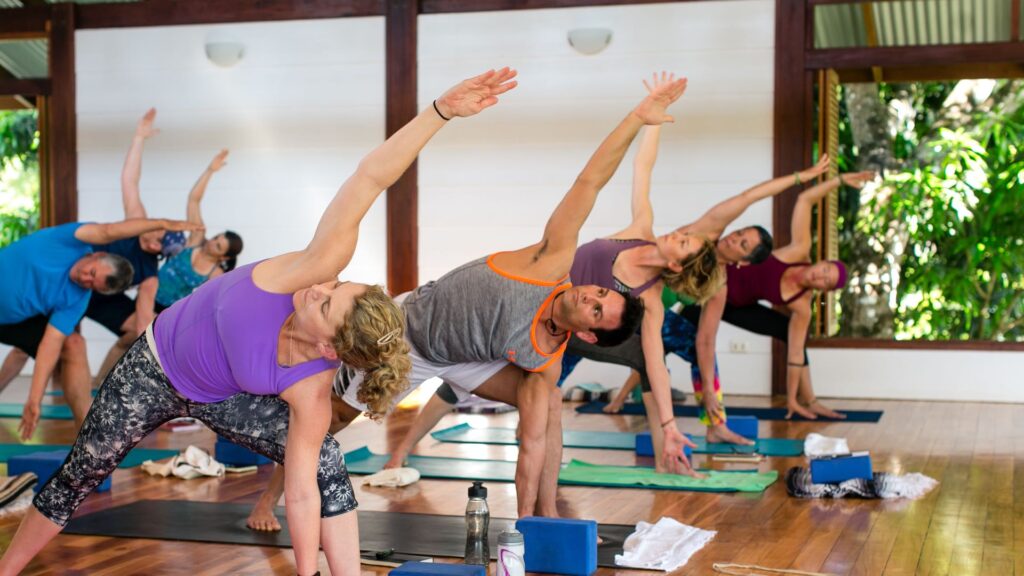
“Stack your hips” means something different to a student with a shallow hip socket than it does to someone with deep acetabular coverage. “Straighten your legs” in Downward Dog is actively counterproductive for students with tight hamstrings or proportionally short femurs. Generic cues assume a generic body — but remember: no such body exists in your classroom.
Skeletal variation alone — the depth and angle of the hip socket, the natural curves of the spine, the length of limb segments relative to the torso — means that the same pose looks genuinely different on different bodies. Not because one person is doing it wrong, but because their bone structure produces a different end position. A teacher without this anatomical literacy will correct what doesn’t need to be touched, and miss what does.
This is one of the most important things yoga anatomy for yoga teachers teaches: how to read a body, not compare it to an ideal.
Core Yoga Anatomy Concepts Every Teacher Must Know
The skeletal system — bones, joints, and range of motion in key poses
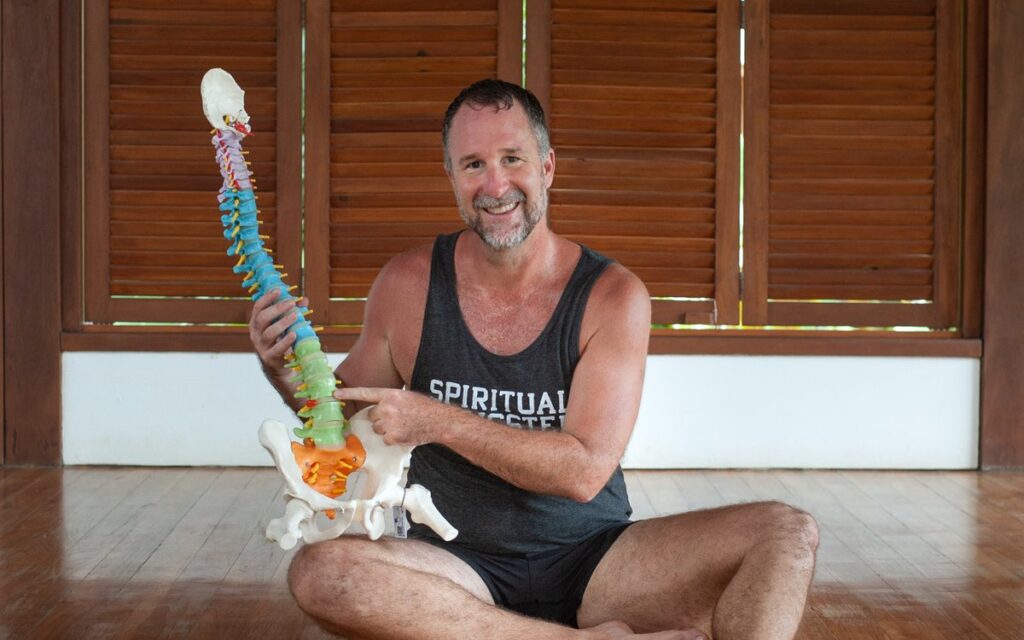
The skeleton is the primary determinant of how far a pose can safely go for any individual student. Key concepts every yoga teacher should understand:
Joint types and their designed ranges of motion
Ball-and-socket joints — hips and shoulders — allow multi-directional movement. Hinge joints — knees and elbows — are designed for flexion and extension only. Asking a knee to rotate is asking it to do something its architecture doesn’t support, which is exactly how meniscus injuries happen.
Spinal anatomy and regional mobility
The five regions of the spine have different degrees of natural mobility. The lumbar spine flexes and extends well but resists rotation. The thoracic spine rotates more freely but is naturally less mobile due to rib attachment. Forcing movement against these regional tendencies — deep lumbar twists, for example — is a primary source of chronic back pain in long-term yoga practitioners.
Bone morphology and individual variation
The angle of the femoral neck relative to the shaft varies by up to 30 degrees between individuals. This single anatomical variation explains why two students with identical flexibility can have dramatically different ranges of motion in hip-opening poses. One student’s “tight hips” may actually be their bone structure — and no amount of stretching will change that.
Learn more here about how to fix tight muscles without stretching.
Muscular anatomy — understanding agonists, antagonists, and how muscles work in yoga
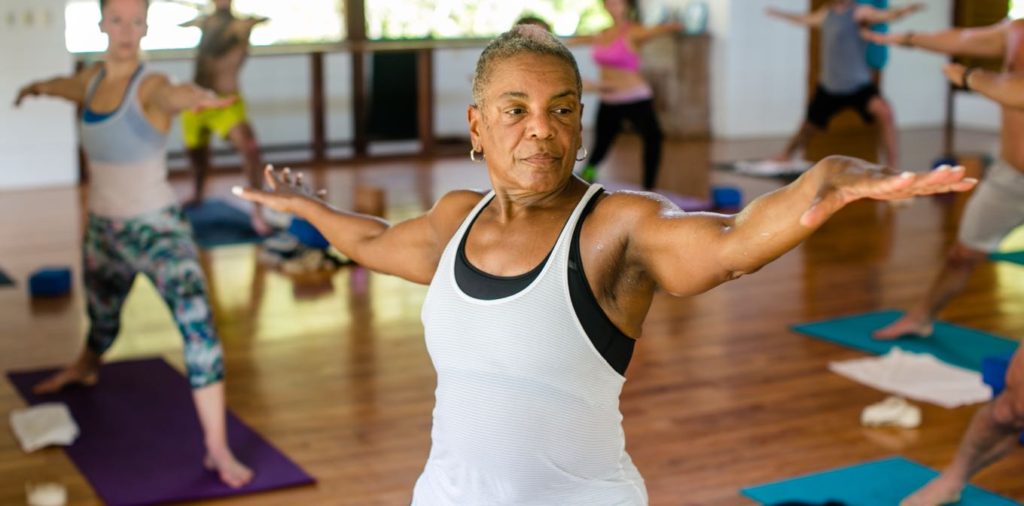
Muscles never work in isolation. Every movement in yoga involves a coordinated relationship between multiple muscle groups:
- Agonists — the primary muscles producing the movement (quadriceps extending the knee in Warrior III)
- Antagonists — muscles on the opposing side that must lengthen to allow the movement (hamstrings in the same pose)
- Synergists — supporting muscles that stabilize the joint during movement (hip abductors preventing pelvic drop)
- Stabilizers — muscles holding proximal joints steady so distal joints can move freely (deep core muscles anchoring the lumbar spine in nearly every standing posture)
Understanding these relationships transforms how you cue. Instead of “engage your core” — a cue so vague it’s nearly meaningless — a teacher with muscular literacy says “draw your low belly in and up to support your lumbar spine.” That cue activates the right muscles, for the right reason, in the right pose.
This is the practical payoff of yoga anatomy for yoga teachers: not knowing muscle names, but knowing what to do with that knowledge in real time, with a real student in front of you.
The nervous system and breath — how physiology shapes the yoga experience
This is where anatomy becomes physiology, and where yoga’s physical and therapeutic dimensions intersect most powerfully.
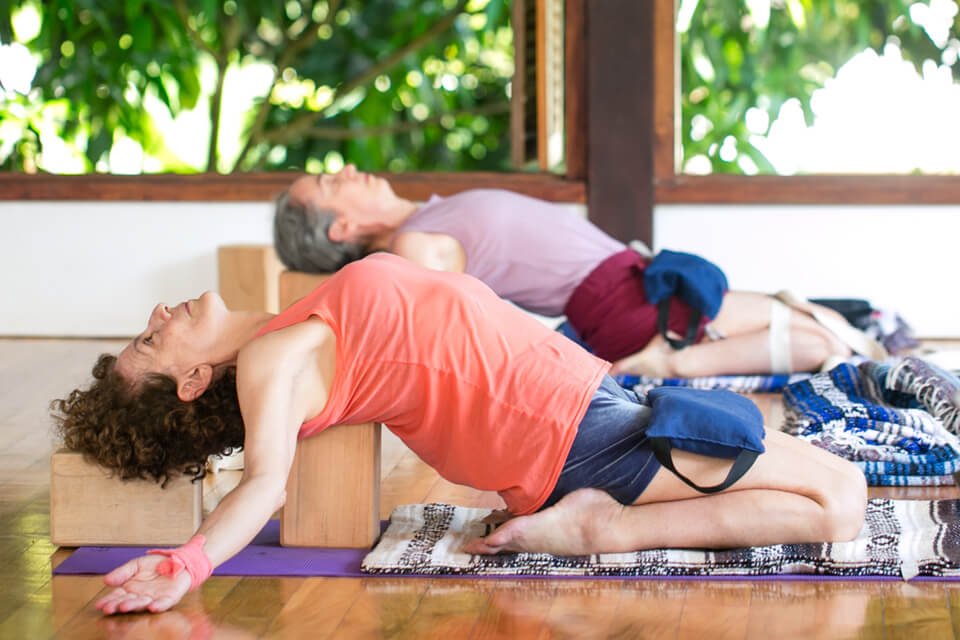
The autonomic nervous system operates in two primary states: sympathetic (fight-or-flight) and parasympathetic (rest-and-digest). Yoga’s well-documented therapeutic effects — reduced stress, improved sleep, lower anxiety — are largely mediated through parasympathetic activation, triggered by slow diaphragmatic breathing and sustained, non-threatening movement.
A yoga teacher who understands this physiology can intentionally design classes that shift students out of chronic sympathetic activation. In practice, this means:
- Prioritizing nasal breathing, which activates the vagus nerve and dampens the stress response
- Holding poses long enough for the nervous system to register safety and release muscular guarding — the myotatic stretch reflex typically settles after 20–30 seconds
- Sequencing from activating to restorative in a deliberate arc, guiding the nervous system rather than choosing random poses
This is a physiology in service of yoga’s deepest intentions — to calm down the fluctuations of the mind – but it’s only accessible to teachers who understand the body well enough to work with it consciously.
How Yoga Anatomy Training Makes You a Better Teacher
Reading your students’ bodies — alignment cues
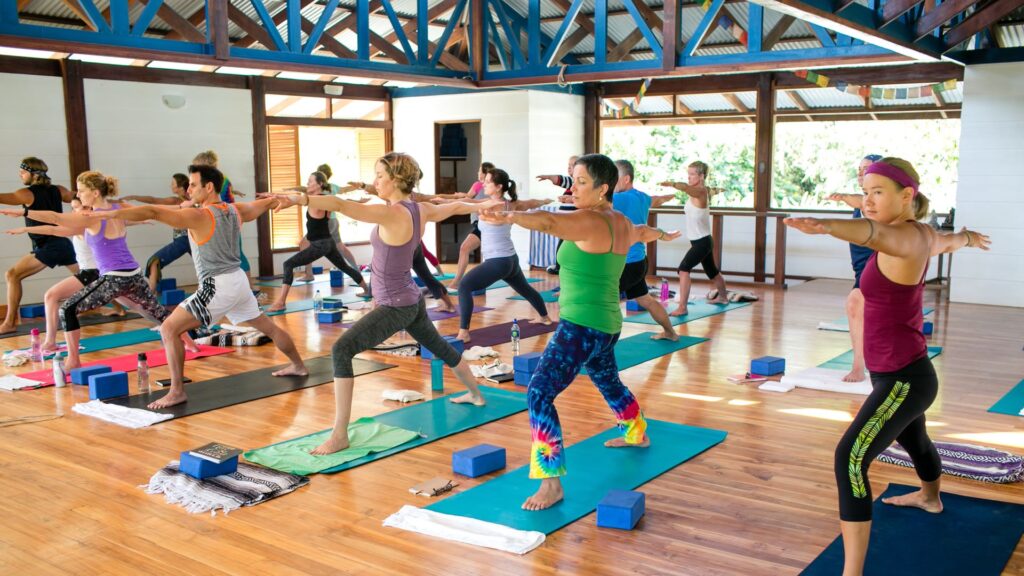
Anatomical literacy changes what you see when you look at a student in a pose. Instead of comparing their shape to an idealized image of the posture, you start reading the body for information: Where is the load falling? Which joint is compensating? Is this limitation muscular or skeletal? Is this person guarding an old injury?
The difference between a cue that helps and one that causes harm is almost always a matter of anatomical knowledge. A teacher who understands hip flexor anatomy knows that pressing a student deeper into Pigeon Pose may be the worst thing they can do, even if the student is asking for more.
Offering modifications that actually work for different bodies
Effective modifications aren’t simply easier versions of poses. They’re anatomically intelligent alternatives that achieve the same physiological goal through a different pathway. A student with a knee injury doesn’t need a watered-down Warrior — they need a variation that loads the quadriceps and opens the hip without compressing the medial joint space.
A student with thoracic kyphosis doesn’t need to be told to “open their chest” — they need strengthening work in the rhomboids and lower trapezius, and an understanding teacher who knows the difference between a postural habit and a structural limitation.
This level of modification is what separates a competent yoga teacher from an exceptional one — and it requires the kind of applied yoga anatomy for yoga teachers that goes well beyond labeling muscles on a diagram.
Designing sequences that build safely toward challenging poses
Peak pose sequencing — building a class toward one demanding posture — is standard across many yoga traditions. Done with anatomical intelligence, it’s a thoughtful preparation. Done without it, it’s how students get hurt.
A teacher who understands the hip flexor complex knows that Pigeon Pose requires systematic preparation through standing hip openers, not cold lunges held for five breaths. A teacher who understands spinal mechanics knows that deep backbends need thoracic mobility work before lumbar extension is asked for.
Sequencing with anatomical intention is one of the most sophisticated — but most learnable — skills that comes from serious yoga anatomy and physiology training.
What to Look for in a Yoga Teacher Training With Strong Anatomy Instruction
The difference between surface-level anatomy modules and applied, embodied learning
There is a meaningful difference between learning anatomy from a textbook and learning it through your own body. Surface-level anatomy instruction covers names, diagrams, and Latin terminology. Applied anatomy instruction asks: what does this feel like from the inside, and how does that translate to what I see in my students?
The distinction matters because anatomy knowledge that lives only in your head doesn’t transfer to your teaching. You need to have felt the difference between an activated glute and a passive one. You need to have experienced what happens in your own spine when your pelvis tilts forward. Embodied anatomy stays with you in a way that memorized anatomy doesn’t.

Questions to ask any YTT program about their anatomy curriculum
Before committing to any yoga teacher training, ask these questions directly:
- Who teaches the anatomy module — a yoga teacher with some anatomy knowledge, or someone with formal training in both disciplines?
- Is anatomy integrated into daily practice sessions, or confined to classroom lectures?
- Does the curriculum address individual anatomical variation, or does it assume one ideal body?
- Are contraindications and injury modifications taught in practical, scenario-based contexts?
- How many of the required 30 hours are contact hours versus independent study?
- Will I leave able to confidently modify poses for students with lower back pain, knee issues, or shoulder impingement?
The answers to these questions will tell you more about the quality of a program’s yoga anatomy for yoga teachers instruction than any marketing page will.
Yoga Anatomy For Yoga Teachers Training at Blue Osa — The AYAMA™ Approach
What makes Applied Yoga Anatomy + Muscle Activation different
Most yoga teacher trainings teach the anatomy of the body. AYAMA™ — Applied Yoga Anatomy + Muscle Activation, developed by Yogi Aaron over three decades of study and practice — teaches anatomy through the body. If you want to understand where this methodology came from and why it exists, Yogi Aaron’s story — from chronic pain to AYAMA™ is worth reading before you go any further.
The central insight behind AYAMA™ challenges one of yoga’s most widely held assumptions: that flexibility is the goal, and stretching is the path to get there. What Yogi Aaron observed — across thousands of students and years of teaching — is that passive overstretching frequently destabilizes joints rather than liberating them. Students become more flexible and more injury-prone simultaneously, because the muscles designed to support their joints are being consistently lengthened rather than strengthened.
If you’ve ever wondered why years of dedicated stretching haven’t resolved your tightness or pain, the answer is almost always muscular — not structural. Why stretching may be making your pain worse is one of the most important questions in modern yoga, and the answer reshapes how you think about every pose you teach.
AYAMA™ inverts this. Before asking a joint to move through a range of motion, teachers trained in this methodology activate the muscles surrounding that joint — creating stability first, mobility second. The results are consistently striking: students who had plateaued for years in certain poses find access. Students managing chronic pain experience relief. Teachers find they can work with a far wider range of bodies, conditions, and limitations than conventional yoga anatomy for yoga teachers training prepared them for.
This is not a minor pedagogical refinement. It is a fundamentally different framework for understanding what yoga is doing in the body — and what a teacher’s job actually is.
How anatomy is taught inside Blue Osa’s 200-Hour and 300-Hour YTT programs
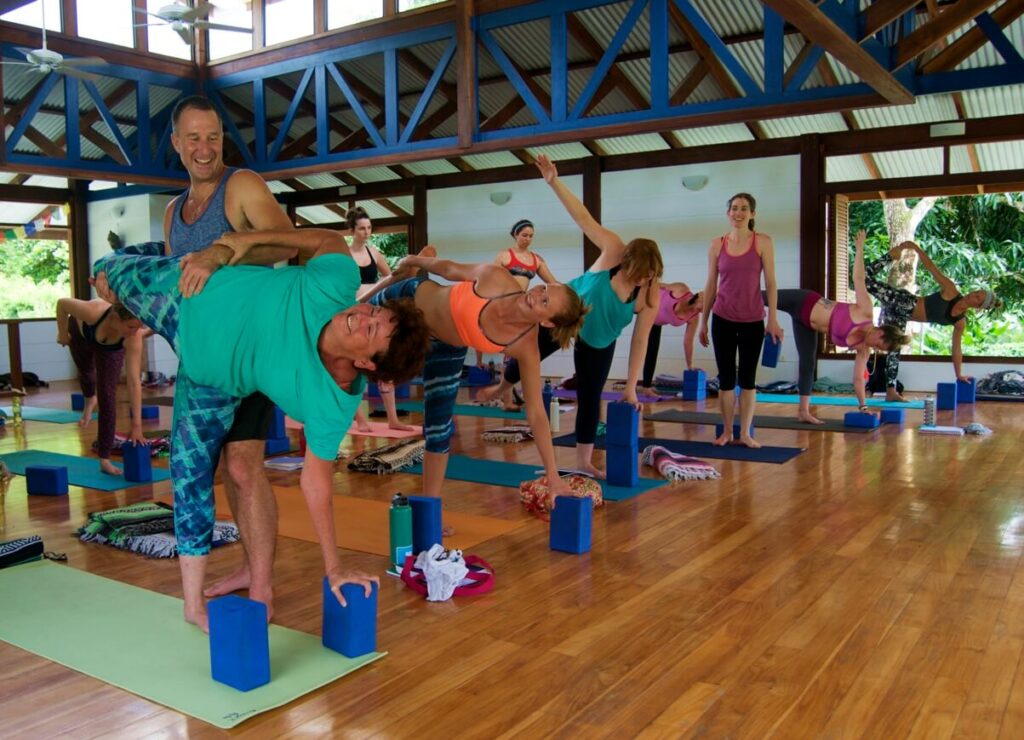
At Blue Osa, yoga anatomy for yoga teachers is not a standalone module delivered in a classroom and then forgotten. It is woven through every day of training — every practice session, every teaching practicum, every discussion of sequencing and cueing.
Students don’t learn that the gluteus medius stabilizes the pelvis and then move on. They feel it working in their own body during practice, learn to cue it for a fellow student, receive feedback on that cue, and refine it. This cycle — concept, sensation, application, feedback — is how anatomical knowledge becomes teaching instinct rather than test-taking material.
The 200-hour program covers the full Yoga Alliance anatomy and physiology curriculum alongside AYAMA™ fundamentals: muscle activation principles, joint stability, skeletal variation, and how to modify for the most common student limitations.
The 300-hour advanced program extends this into yoga therapeutics — working with students managing specific conditions including chronic lower back pain, knee injuries, shoulder dysfunction, and scoliosis. Graduates of the 300-hour program leave with a level of anatomical confidence that most 500-hour programs don’t consistently produce.
Both programs take place at Blue Osa’s beachfront retreat on Costa Rica’s Osa Peninsula. If you want to understand what that experience actually looks like day to day — the schedule, the environment, the pace of learning — the full guide to Costa Rica Yoga Teacher Training immersion covers it in detail. It’s a deliberately remote setting, chosen because deep anatomical learning requires the kind of focus that a commute and a full inbox make nearly impossible. As it turns out, the nervous system absorbs new information considerably better when it isn’t managing a commute.
Frequently Asked Questions
Q: Is yoga anatomy hard to learn if I have no science background?
Not at all. Yoga anatomy for yoga teachers is taught through movement and sensation, not textbooks. If you can feel your body in a pose, you already have the foundation. Most students are surprised by how quickly it clicks when it’s taught in an embodied, practical context rather than a lecture hall.
Q: How is yoga anatomy for yoga teachers different from regular anatomy?
Regular anatomy is studied in the context of medicine — diagnosis, surgery, pathology. Yoga anatomy applies the same structural knowledge to movement, breathing, and posture. The focus is on how muscles, joints, and the nervous system behave during yoga practice specifically, and what that means for how you teach.
Q: Can I teach yoga safely without formal anatomy training?
You can teach — but you’ll have significant blind spots. Without understanding how joints load, how muscles work together, and how skeletal variation affects range of motion, you’re relying on generic cues that don’t account for the real bodies in front of you. Formal yoga anatomy training closes those gaps systematically.
Q: What’s the difference between a 200-hour and 300-hour YTT in terms of anatomy?
A 200-hour program covers anatomy and physiology fundamentals — the skeletal and muscular systems, breathing mechanics, and basic contraindications. A 300-hour program goes deeper into yoga therapeutics: working with specific injuries, chronic conditions, and individual anatomical variation. If you want to work confidently with students who have pain or limitations, the 300-hour level is where that confidence is built.
Q: How long does it take to feel confident applying anatomy in class?
Most teachers report that the concepts begin integrating into their teaching within the first few weeks of consistent practice after training. The shift from knowing anatomy to seeing it in your students’ bodies takes time — but it accelerates quickly once you start looking for it. Teachers who train in immersive, residential programs like a YTT retreat tend to make that transition faster because the learning environment removes distractions and compresses the timeline.

Ready to train with a methodology that takes yoga anatomy for yoga teachers seriously? Learn more about Blue Osa’s 200-hour and 300-hour YTT programs in Costa Rica — and find out whether AYAMA™ is the missing piece your teaching has been looking for.
About The Author, Yogi Aaron

Yogi Aaron is the founder and creator of Applied Yoga Anatomy + Muscle Activation™ (AYAMA), a revolutionary methodology that challenges conventional approaches to yoga. Using a science-backed approach, he prioritizes muscle activation over traditional stretching.
With over three decades of dedicated study, mentorship, and hands-on experience, he has established himself as a leading expert in yoga therapy, alignment, and pain-free movement.
As owner and operator of Blue Osa Yoga Retreat + Spa in Costa Rica, Yogi Aaron leads transformative programs that combine his expertise in yoga instruction, retreat facilitation, and wellness business operations. His work spans both in-person immersive experiences and digital education through The Yogi Club online platform and the AYAMA™ Certification Program.
Yogi Aaron’s teaching methodology represents a paradigm shift in modern yoga practice. AYAMA focuses on activating and engaging muscles to enhance range of motion, build strength, improve stability, and optimize alignment—while reducing pain and injury risk. This evidence-based approach has positioned him as a thought leader challenging the status quo in the yoga community.
His mission extends beyond the mat: to liberate individuals from chronic pain and guide them toward discovering yoga’s authentic purpose through intelligent, body-informed practice.
Learn more about training opportunities with Yogi Aaron at Blue Osa Yoga Retreat + Spa.
Check out these other popular posts!


Book/Inquire Now
Got pain? This will help you!

YOU DESERVE TO LIVE PAIN-FREE...
Receive 7 short, simple, and effective practices to alleviate knee, hip, low back, neck, shoulder pain, and more!
All you need is 5 minutes per lesson and it's FREE!
This revolutionary approach to yoga is new, and no one else is teaching this! Since I created Applied Yoga Anatomy + Muscle Activation™ and started teaching it consistently, I've witnessed students heal long-standing injuries, access yoga postures they never thought possible, and tell me over and over again how their body just feels better.
I hope you'll join me on this journey!
~Yogi Aaron
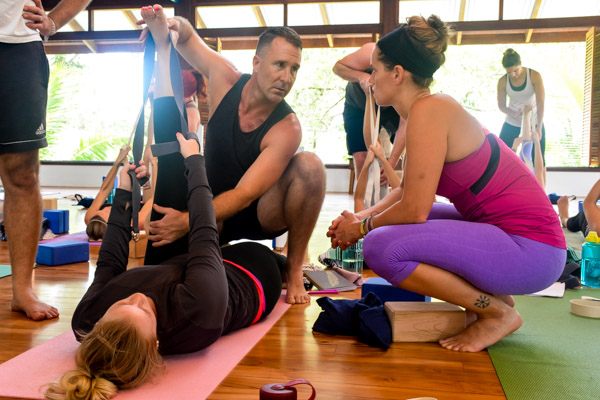
Is Yoga Teacher Training Right For Me?
We Created This FREE 5 Part Series So You Can Get All The Information To Make The Right Choice.
In this series, you will learn:
-
- Am I a candidate for yoga teacher training??
-
- What will I learn in a YTT?
-
- Do I need to have a perfect downward dog to attend YTT?
14-Day 200-Hour Yoga Teacher Training in Costa Rica
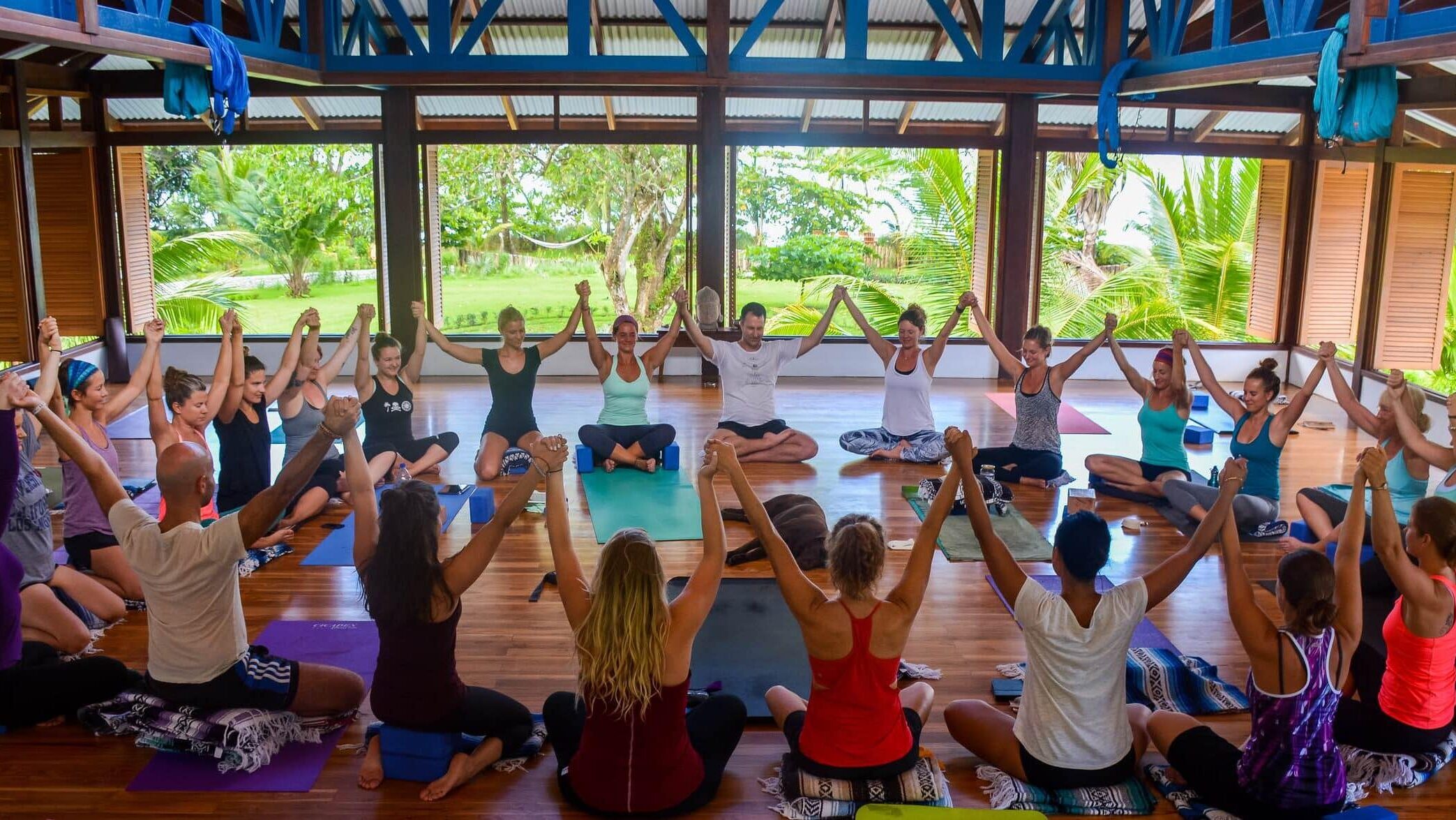
If you are looking for a 14-day 200 hour Yoga Teacher Training Costa Rica Immersion, you have landed in the right place. Join the next one!
300-Hour, 28-Day Yoga Teacher Training
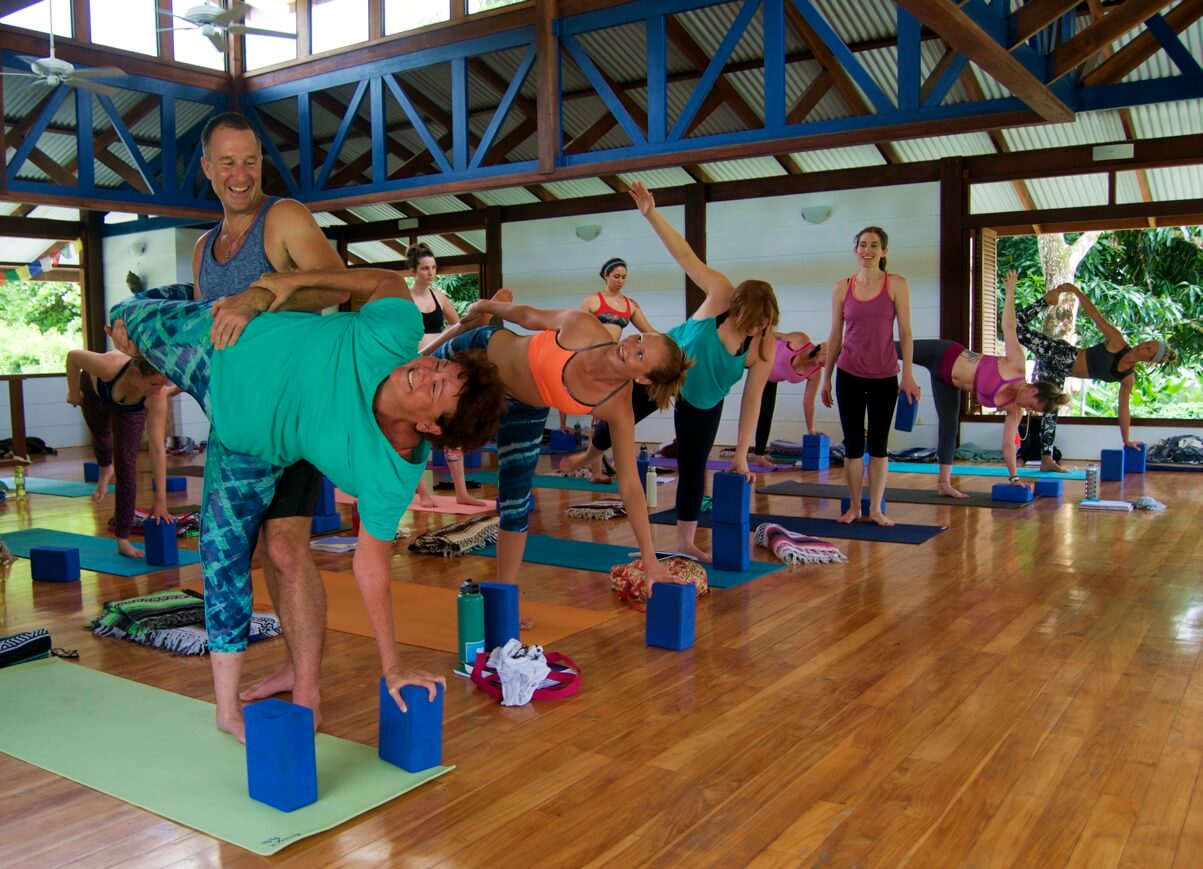
Do You Feel Called To Something Greater?
This 300-Hour Yoga Teacher Training immersion training at Blue Osa will immerse you in yoga for one month.
You will have the specific transformational skills and yogic practices you need in order to connect with your higher purpose.
And more! You will be able to offer these transformative skills to others!
